Why you understand
words you can't say
Because understanding a word and producing one are different tasks, and nearly everything you do trains only the first. Passive vocabulary runs ahead of active vocabulary at every level: Laufer (1998) followed learners across a school year and found passive vocabulary grew while free productive use did not move at all. The gap is not evidence of bad learning — it is what input produces. What closes it is being asked for the word, and having to come up with it before anything reveals it.
Every figure below is sourced at the end of the page
What “knowing a word” measures, from easiest to hardest
Vocabulary size is not one number, because the answer changes with the question. The same word can be solidly known on one test and absent on another taken five minutes later, and the difference between those tests is not difficulty in the vague sense — it is how much of the word the task hands you before asking for the rest.
Lay the common tasks out in order and the pattern is uncomfortably clear: almost all ordinary study lives in the top two rows, and almost all actual speaking lives in the bottom one.
| What the task asks of you | What it measures | What research finds |
|---|---|---|
| You meet the word in a sentence and follow it | Receptive recognition, fully cued | The first knowledge to appear and the last to go (Nation, 2001) |
| You pick the meaning from four options | Recognition, with elimination available | Flattering: part of the score comes from ruling out, not from knowing |
| You see the foreign word and give the meaning | Receptive recall — the reading direction | Harder than recognition, and teaches more: recall tests beat recognition tests (Glover, 1989) |
| You see the meaning and must produce the word | Controlled productive knowledge | Consistently below passive knowledge in every group (Laufer & Paribakht, 1998) |
| You use the word unprompted in speech or writing | Free productive use — what “speaking” means | The only measure that did not grow at all over a year of study (Laufer, 1998) |
Read the rows as an ordering, not as a scale with fixed ratios. Melka (1997) argues that receptive and productive knowledge are degrees along one continuum rather than two separate stores, and the measured gap between them moves with the test format, the learner's level and how much the word looks like something in their first language. What survives all of that is the direction of the inequality: whatever the numbers, the free-production column is the shortest.
Three different things get called “I know this word”
The complaint “I understand it but I can't use it” hides three separate states, and they need different work. Naming yours is worth more than another hundred cards, because two of the three are not gaps in knowledge at all — they are gaps in access.
- You know it when you see it. The form is familiar, the meaning arrives, and nothing more is required — because the text supplied the word. Tulving and Pearlstone (1966) separated availability from accessibility: words people could not produce freely reappeared as soon as a cue was given. Recognition is that state, and reading gives you a cue on every line.
- You can go one way but not the other. You see the foreign word and the meaning comes; you want the foreign word and nothing comes. Mondria and Wiersma (2004) tested exactly this and found learners largely gain the direction they practised — receptive practice built receptive knowledge, productive practice built productive knowledge. Direction is not a detail of your flashcards; it is what they teach.
- You can produce it but not place it. The word arrives, but with the wrong preposition, the wrong register or the wrong collocation. Nation (2001) treats knowing a word as a bundle — form, meaning, grammar, collocation, constraints on use — and Webb (2007) found that after ten encounters several of those components were still incomplete. This one genuinely needs more encounters, not just harder ones.
The decay question — what happens to any of these between encounters: why do I forget vocabulary I've learned.
Which of your habits builds which vocabulary?
Every row below is a normal, sensible thing learners do. None of them is a mistake. But each one trains a specific direction, and the ones that feel most productive — because they are smooth and cover a lot of words — are precisely the ones that never let a retrieval attempt happen.
| What you actually do | What it trains | What it leaves untouched |
|---|---|---|
| Watching shows with subtitles | Recognition in context, listening, chunks | The subtitle answers before you can attempt anything — no retrieval ever starts |
| Reading with tap-to-translate | Fast coverage, form–meaning links, reading fluency | The tap does the retrieval for you; the effort that would have built recall is skipped |
| Multiple-choice quizzes | Recognition, and a satisfying score | Free recall — elimination gets you partway without knowing the word |
| Cards that show the foreign word | Receptive recall — genuinely useful for reading | Production: you are never once asked to come up with the word itself |
| Cards that ask for the foreign word | Productive recall — the direction that transfers | Costs more time per word (Mondria & Wiersma, 2004); the difficulty is the mechanism |
| Conversation practice | Free production under real pressure — the target skill | Only the words you already have: you route around the rest and never notice |
The honest reading of this table is not “stop watching shows”. Input is where words are met, and there is no substitute for volume. The point is that a week made entirely of the first four rows can feel like hard work and still leave free production exactly where it started — which is the year Laufer (1998) measured. A small number of retrievals in the fifth row is what changes the shape of the week.
Your passive vocabulary is the cheap raw material
The gap sounds like a verdict on wasted years. It is closer to the opposite. A word you recognise already has a form and a meaning attached to each other; what is missing is a route from the meaning back to the form. That is a smaller job than building a word from nothing, which is why the highest-yield material most learners have is not the next thousand words — it is the words they already half-know and have never once been asked to produce.
The direction of transfer makes the same point. Webb (2009) compared receptive and productive learning of word pairs and found the productive condition raised productive knowledge, as expected, but also carried receptive knowledge along with it; the receptive condition largely stayed on its own side. Mondria and Wiersma (2004) found the matching cost: productive learning takes longer per word. Both results push the same way — the harder direction is the more general one, and paying for it buys the easy direction as a by-product.
This is Bjork's (1994) desirable difficulty in a very ordinary setting. The card you fail feels like evidence that the method is not working; it is the only card that did any work. Ease during practice predicts almost nothing about what you will still have next month, and the smooth, satisfying study session — the one where every answer arrives instantly — is usually the one where nothing had to be retrieved.
What actually converts a passive word into an active one
Four things decide whether a word you understand ever becomes a word you can say. Three of them are well-studied and produce effects large enough to see without statistics. The fourth has no literature at all, because it is not a memory question — and it is the one that settles the outcome for most people.
Read the right-hand column as the size of the prize rather than as a fine adjustment. The distance between retrieving and re-reading is roughly the distance between remembering most of a list and remembering a third of it.
| What moves a word | The evidence | How big the effect is |
|---|---|---|
| Attempting recall instead of re-reading | Karpicke & Roediger (2008); Glover (1989) on test format | Recall a week later fell from about 80% to about 35% when repeated retrieval was dropped |
| Practising in the productive direction | Webb (2009); Mondria & Wiersma (2004) | You gain the direction you practise — and productive practice also lifts receptive scores, not the reverse |
| Enough encounters, spread out | Nation & Wang (1999); Webb (2007); Cepeda et al. (2006) | Roughly 8–12 spaced encounters; about 47% recalled spaced against 37% massed |
| Whether the attempt happened at all | No study needed — a retrieval that never happened has no effect size | Decisive. The three rows above are worth nothing on the days nothing is opened |
Nothing in this table requires a course, a tutor or a method. It requires being asked for a word, in the awkward direction, a handful of times, on days that are spread apart — and the last row says the whole thing lives or dies on whether that ask ever reaches you.
Being asked for the word, without booking time for it
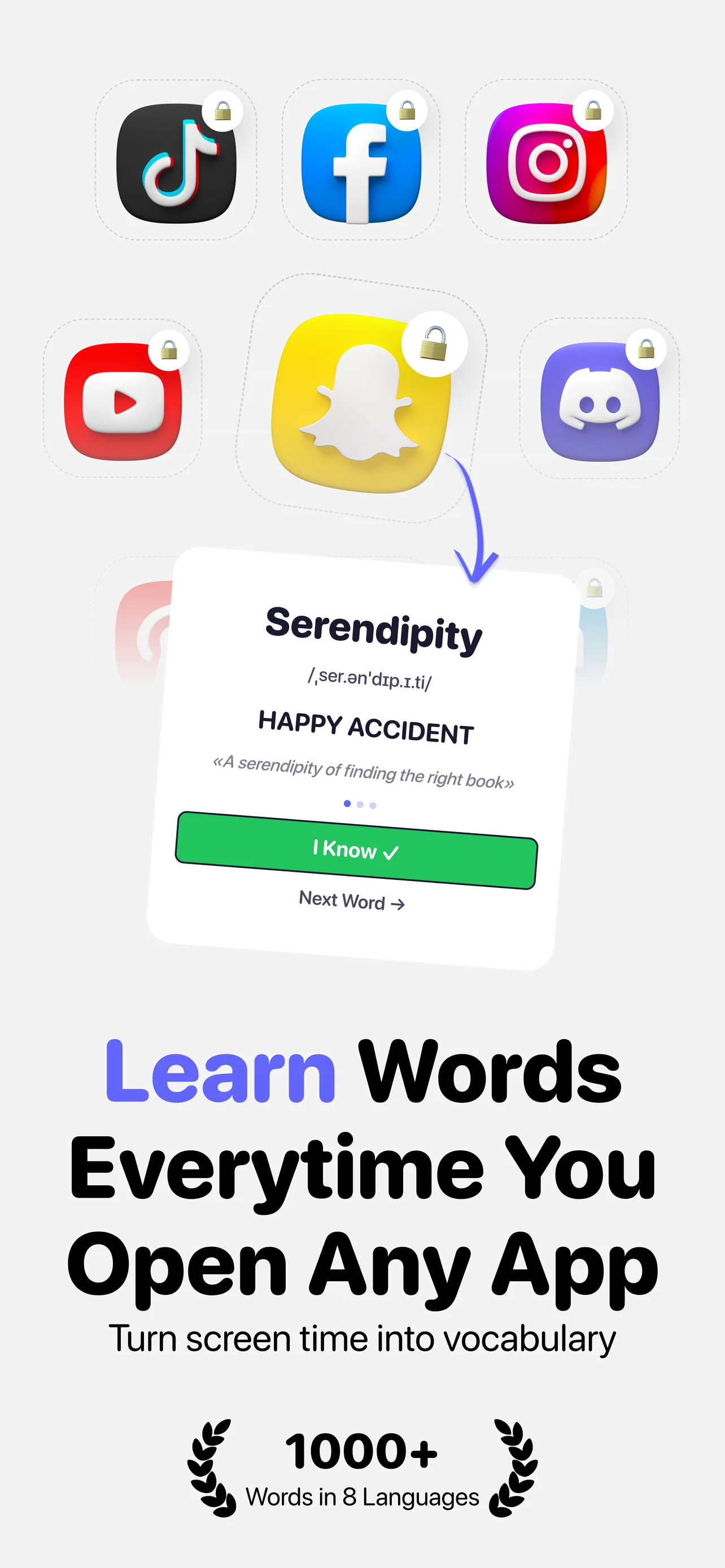
If the decisive row is the fourth one, the thing worth automating is not the studying but the asking. That is the shape LearnScreen is built in: the retrieval attempt arrives inside a moment that already exists in your day.
The question comes to you
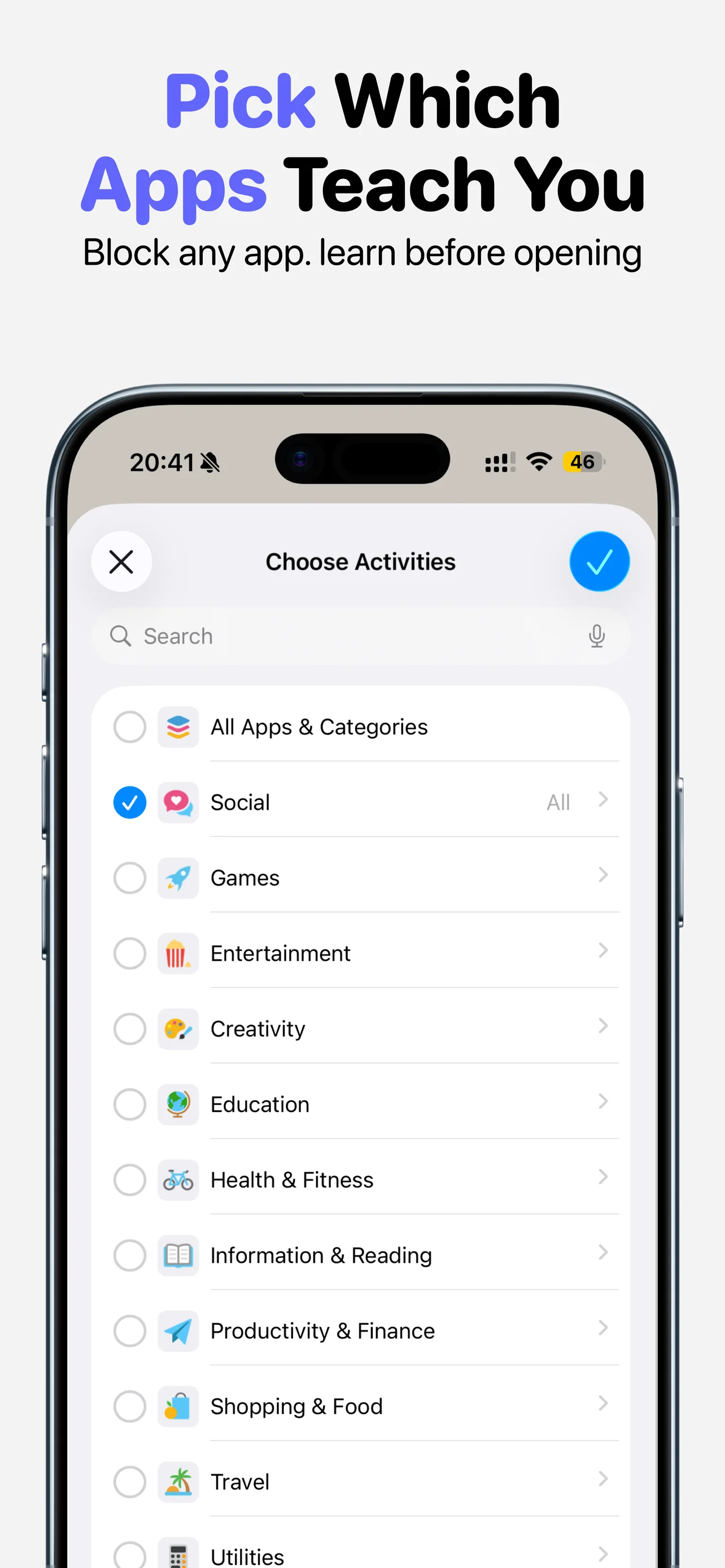
Phones get checked about 186 times a day, roughly 11.6 times per waking hour (Reviews.org, 2026). Using Apple's Screen Time API, LearnScreen shields the apps you choose and puts a word there instead — so the ask lands on a reach you were making anyway, with nothing to open and nothing to remember.
It waits for your attempt
The card holds the answer back until you tap. That pause is the entire difference between the ~80% and the ~35% in Karpicke and Roediger (2008) — and unlike a subtitle or a dictionary tap, it cannot answer on your behalf. It costs about twenty seconds.
The gaps widen by themselves
A Leitner schedule promotes the words you got and brings back the ones you missed, so the interval stretches as the word firms up — without you scheduling anything. The words on the edge of slipping come round first, which is where an attempt is worth most.
- You set the dose. Words per session adjust from 3 to 20, as does how often the shield returns — the defaults come to roughly 25 recall attempts a day, about two and a half minutes spread across it.
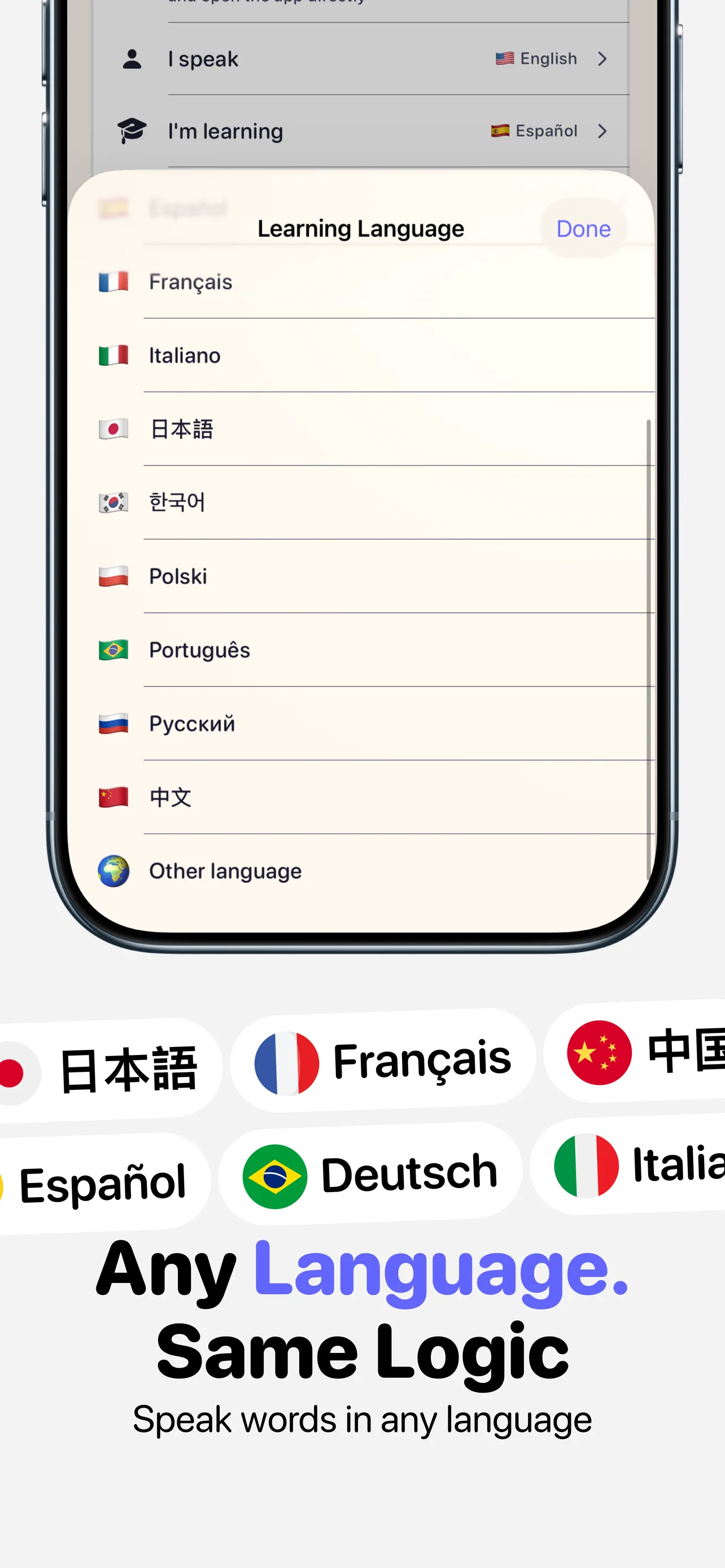
- 1,080+ curated words across 18 topics. Eleven languages are supported as learning targets, and you can add unlimited custom words with translation, transcription and an example sentence — so a word you keep failing gets a context to hang on.
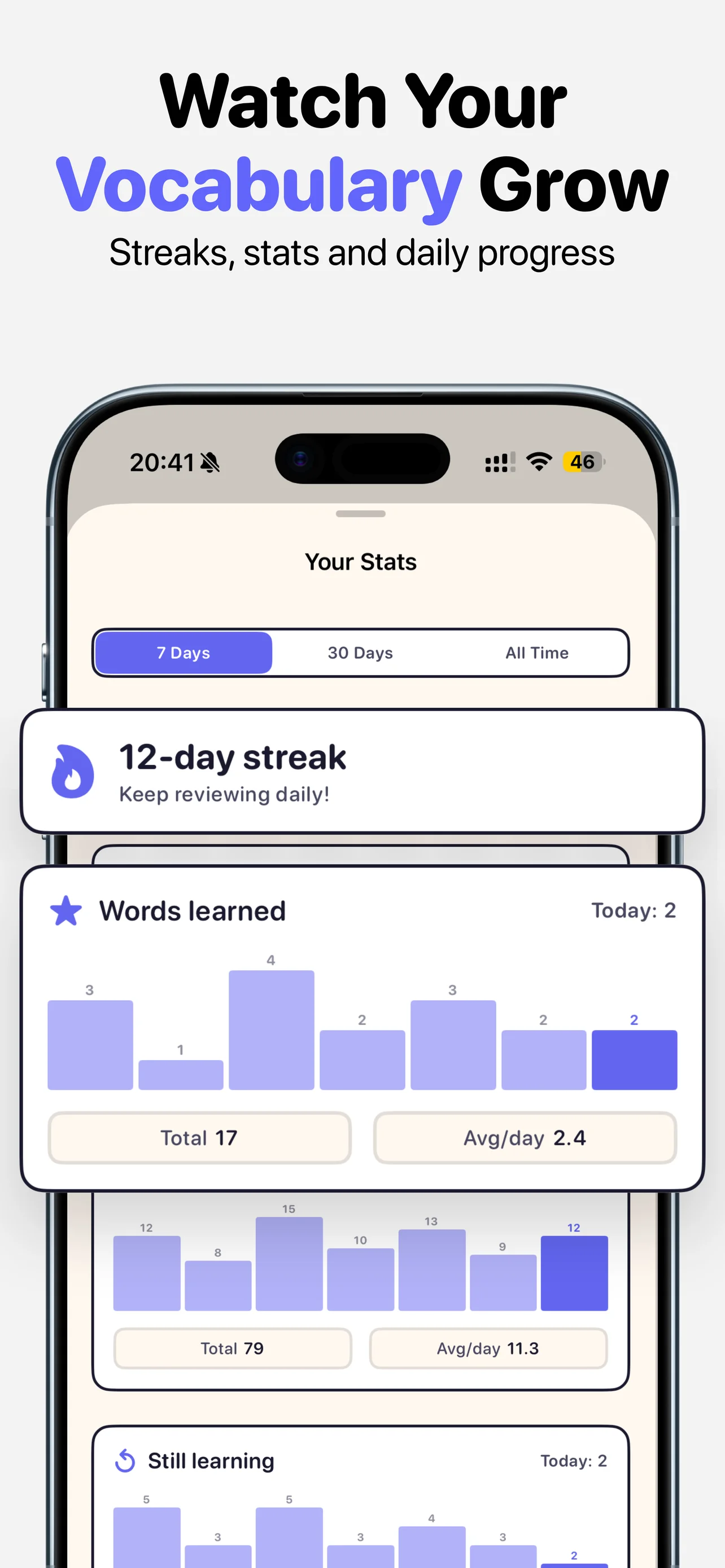
- Nothing is lost when you fall behind. There is no streak to break and no penalty for a quiet week; the words you missed stay in the queue, and a half-known word is cheaper to finish than a new one is to start.
- It works offline, with no account. Cards and shields run without a network once installed; iCloud backup writes to your own private database rather than our servers, and there is nothing to sign up for.
Related reading
- Why do I forget vocabulary I've learned? — what happens to a word between encounters, and why relearning is cheaper.
- How often should you review vocabulary? — the intervals that catch a word before it slips.
- How many times do you need to see a word? — where the 8–12 encounters figure comes from.
- Does passive learning actually work? — what exposure alone produces, and where it stops.
- How many words do you need to speak a language? — the size of the target, by coverage and CEFR level.
- A passive Anki alternative — spaced repetition that does not wait for you to open it.
- How do you stay consistent? — why the plan is rarely what fails, and what a routine needs to survive.
Frequently asked questions
Sources
- Laufer, B. (1998). The development of passive and active vocabulary in a second language: same or different? Applied Linguistics, 19(2), 255–271.
- Laufer, B., & Paribakht, T. S. (1998). The relationship between passive and active vocabularies: Effects of language learning context. Language Learning, 48(3), 365–391.
- Melka, F. (1997). Receptive vs. productive aspects of vocabulary. In N. Schmitt & M. McCarthy (Eds.), Vocabulary: Description, Acquisition and Pedagogy (pp. 84–102). Cambridge University Press.
- Nation, I. S. P. (2001). Learning Vocabulary in Another Language. Cambridge University Press.
- Webb, S. (2009). The effects of receptive and productive learning of word pairs on vocabulary knowledge. RELC Journal, 40(3), 360–376.
- Mondria, J.-A., & Wiersma, B. (2004). Receptive, productive, and receptive + productive L2 vocabulary learning: What difference does it make? In P. Bogaards & B. Laufer (Eds.), Vocabulary in a Second Language (pp. 79–100). John Benjamins.
- Tulving, E., & Pearlstone, Z. (1966). Availability versus accessibility of information in memory for words. Journal of Verbal Learning and Verbal Behavior, 5(4), 381–391.
- Roediger, H. L., & Karpicke, J. D. (2006). Test-enhanced learning: Taking memory tests improves long-term retention. Psychological Science, 17(3), 249–255.
- Karpicke, J. D., & Roediger, H. L. (2008). The critical importance of retrieval for learning. Science, 319(5865), 966–968.
- Glover, J. A. (1989). The “testing” phenomenon: Not gone but nearly forgotten. Journal of Educational Psychology, 81(3), 392–399.
- Cepeda, N. J., Pashler, H., Vul, E., Wixted, J. T., & Rohrer, D. (2006). Distributed practice in verbal recall tasks: A review and quantitative synthesis. Psychological Bulletin, 132(3), 354–380.
- Nation, I. S. P., & Wang, K. (1999). Graded readers and vocabulary. Reading in a Foreign Language, 12(2), 355–380.
- Webb, S. (2007). The effects of repetition on vocabulary knowledge. Applied Linguistics, 28(1), 46–65.
- Bjork, R. A. (1994). Memory and metamemory considerations in the training of human beings. In J. Metcalfe & A. Shimamura (Eds.), Metacognition: Knowing about Knowing. MIT Press.
- Reviews.org (2026). Cell Phone Usage Stats. Survey of ~1,000 US adults, fielded Q4 2025. Report
The passive/active findings describe classroom learners of English tested on written measures; they establish the ordering, not a fixed ratio for any individual. Retrieval and spacing effects come from the studies named in each row. Card counts and daily totals are arithmetic from a roughly twenty-second recall attempt, not measured app data.
Get asked for the word, not shown it
LearnScreen puts the awkward direction — meaning first, word second — into phone checks you were making anyway. All it asks of you is the twenty seconds of attempt that nothing else in your day requires.
Download on the App Store